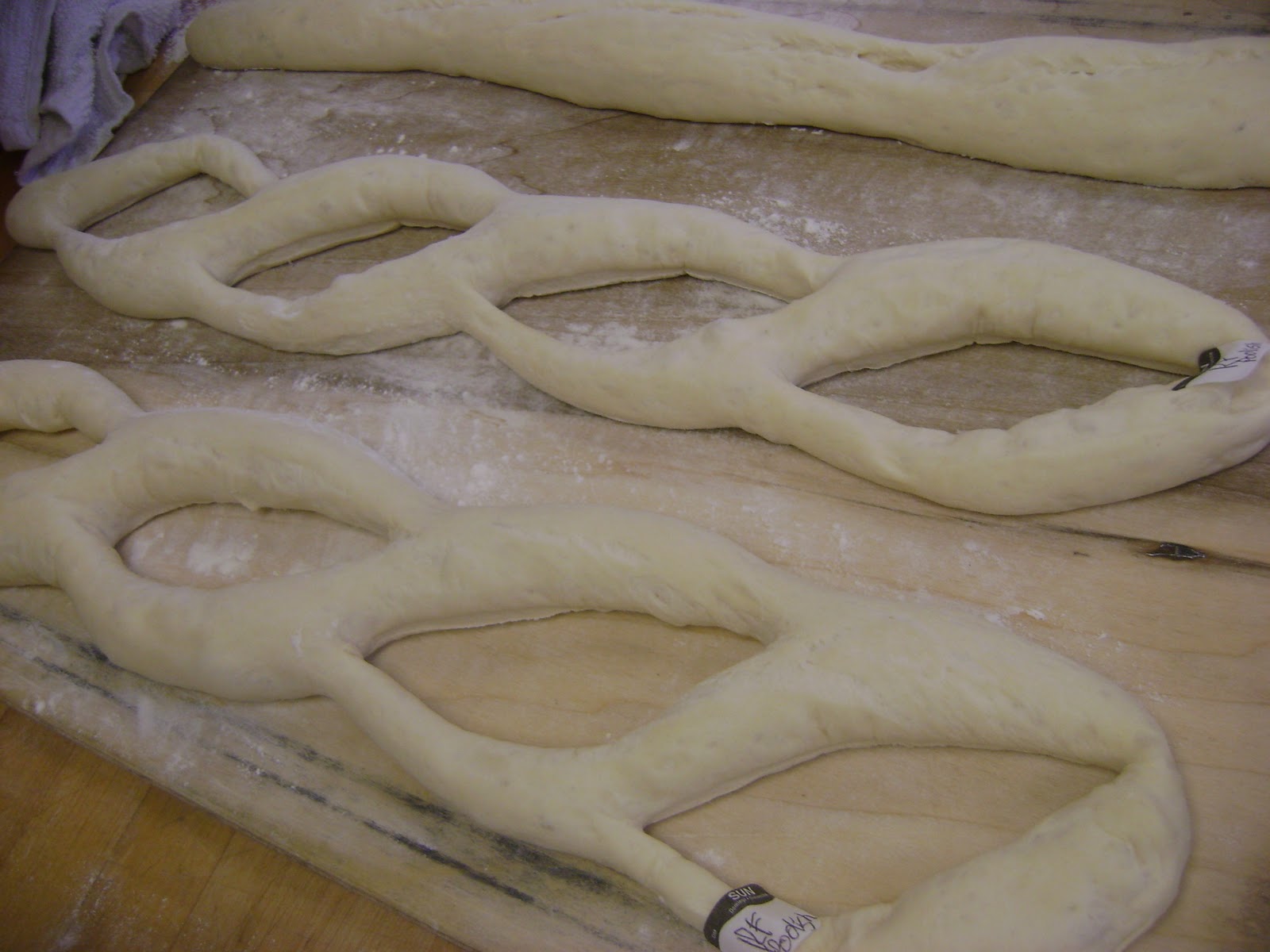
2010-10-13

Artisan Bread Day 6- Sourdough

Team 1
-Pain au Levain
-Gold rush
Team 2
-Vermont sour
-Pain au Levain w/ starter


2010-10-12

Arisan Bread Day 5- Grain Soakers

Semolina


Semolina


Whole wheat


Team 1
-Raisin Walnut

5 grain


-5 Grain w/ saoker
Team 2
-Whole Wheat w/ soaker
-Semolina
The semolina turned out horribly so it is redone on day 6

There are two ways to soak seeds and grains- hot and cool. The hot soaker kills amylase and the seed gelitinize. So the cold water soaker is perfered.

5 grain
5 grain
raisin walnut
There was a scaling error for the preferment on the whole wheat. It was too liquidy. We recalcuated the whole formula- being 5lbs short somewhere. we added 2.65 lbs of flour, making the preferment 27% instead of 35%

The semolina called for a sponge starter. It was mixed with cold water- so the dough never fermented enough. The dough didnt rize and the whole thing turned out awful.

Raisin walnut
The raisins were rehydrated in room temp water- so they didnt suck up the moisture from the bread or burn.

We mixing the ww and the 5 grain first- the ww preferment was over ripe and needed to be used imediately. And the walnuts for the bread were just then taosted and were too hot- plus the allergies to nuts.

To make a batard take the top corners and fold down into the middle. fold in half. sealing edges and fold in half again. roll the dough on its seam and use thumbs to pull the dough tight on top

Raisin Walnut
Batard is the French word for the English bastard. it is half the length of a baguette and fatter. it should be foot ball shaped- tapered at the ends

The semolina with apricots was a sticky dough so it was shaped into a batard- free form.
the top corners were folded down, then it was rolled up. again using thumbs to tighten the dough

Arisan Bread Day 4- Potato and Rustique

Team 1
-Poolish Baguette
-Roasted Potato Bread
Team 2
-Pate Fermentee Baguette
-Pain Rustique

There was a scaling error for the poolish baguette. It came off way too liquidy. about 10lbs of flour was added to counter act the error.

The Pate Fermentee baguette came off the mixer hot at 77, so it only bulk fermented an hour. (instead of one and a half)

Seeded baguette
The pate fermentee baguette dough was not folded- by mistake. so the dough was not preshaped- as to not over work it.


To seed the baguettes- first roll the dough on a damp towel then roll in the seeds. The seeded bread in hard to score so we just made it ladder.
Ladder

Ladder

Seeded ladder
 Pain Rustique
Pan Rustique

The Pain rustique got no preshape or final shape. It was stretched out slightly - touching as little as possible. but it was kept in the same shape as it was portioned.
Roulade
Pate fermentee baguette with guryer
5k of the pate fermentee was rolled out 1/4 inch think and 1k of guryer was spread out on top. it was then rolled up and cut into 4inch slices.
4inch slice


Roasted Potato Bread
The dough (before adding the potatoes) was at improved mix but only at 73 degrees, and the potatoes were at 54. As soon as the potatoes were mixed in(by spinning the bowl backwards) -the dough was put into bins -In the proofer- to bulk ferment

Roasted Potato Bread Dough
The preshape was a light round and the final shape was a fendu. First the dough was rolled into a tight round and allowed to bench rest for about five minutes. The dough is then dusted lightly with flour. A dowel rods is pressed down into the dough- all the way to the bottom- and rolled slightly.


The Dough is placed in the banneton seam side up

proofed and marked- ready for the oven

Banneton vs Couche

2010-10-10

12 steps

1. Scaling
2. Mixing
3. Bulk Fermentation
4. Folding
5. Portioning
6. Preshape
7. Bench Resting
8. Final Shaping
9. Proofing (+scroing)
10. Bake (+steam)
11. Cool (well ventalated)
12. Storing (AVOID staling!)

2010-10-09

Arisan Bread Day 3- Ciabatta and Baguettes

The class is split into two teams (by last name).
Team 1- Poolish Baguette and Biga Ciabatta
Team2- Pate Fermentee Baguette and Poolish Ciabatta

I am on Team 1
Poolish Baguette
Poolish
Bread Flour 9.8 lbs
Water 9.8 lbs
Yeast .02 lbs
Final Dough
Bread Flour 19.8 lbs
Water 9.7 lbs
Yeast .6 lbs
Salt .28lbs

Biga Ciabatta
Biga
Flour 7.7
Water 4.6
Yeast .01
Final Dough
Flour 17.9
Water 14.1
Yeast.27
Salt .5

Even though the ciabatta has a 3 hour fermentation time we mixed the baguette first to avoid bottlenecks- (everything going in the oven at the same time)

For mixing- it is important to reserve water- when first mixing the dough together- in case of scaling error and other factors, it is vital to get the hydration right.
Mixing the cibatta- When using a stiff preferment (Biga, pate fermentee, levian) where the hydration is low or balanced, it is added once the dough is mixed. (meaning the ingredients for the final dough is mixed- flour, water, yeast, salt- then the hydration is adjusted, and THEN the preferment is added)

 Remember to taste the dough- make sure the salt is added
Salt makes the dough very elastic. If no salt it added the dough develops very quickly. - it can still be added- during the first stages of mixing. If too much salt is added more flour and water - proportionally by %

Remember to temp the dough- if the dough is improved and at DDT- take it off!
Spiral mixer
In the Hobart the dough hook picks the dough up and slams it against the wall. The spiral mixer gentaly massages the gluten. and the hook and bowl spin simultaneously.
Controls for spiral mixer, takes a minute to figure it out
Oil the bins with olive oil for bulk fermentation- its easier to get the dough out- cover with plastic to prevent skin forming.
The baguette dough is folded once, and the ciabatta three times. When folding the dough gains strength, the gluten alines, and it absorbs more water (gets less sticky).

The baguette  is portioned at 12oz and rolled into a light ball- preshaping gives the dough a uniform shape and skin, it keeps the gas in
It is benched rested for 20 min then shaped
for shaping the baguettes
from roll- flatten and fold top to bottom
turn 180 and fold top to bottom-(like a letter) sealing the edges with your palm
fold in half
roll out middle to edges like a snake
(so third, third, half)
The baguette proofed for an hour
Baguettes proofing in a couche
Baked at 480- a few seconds of steam is released before the bread is placed in the oven. then a few more seconds are released. once the bread showed some color- the damper is pulled. (all lean dough gets steam)
Finished Baguette
The ciabatta gets no preshape. it is portioned and left to bench rest. After the bench rest poke lightly and stretch out. toppings can be placed on the bread before or after proofing


Arisan Bread Day 2- Decorative Doughs

Decorative breads are as old as bread itself. A few resent examples used to day: cornucopia, and fun animal shaped rolls.

 There are two kinds of decorative dough, yeasted and dead (pate morte). 

Pan Fantaisie (mixed for the class 20k)
Water 6.76k 52%
Bread Flour 5.2k 40%
Rye Flour 5.2k 40%
Whole Wheat 2.6k 20%
Salt .26k 2%
Freash Yeast .13 k 1%
Butter .26k 2%

The dough is treated like any other dough- following the 12 steps- NO FERMENTATION
It bench rested for 25min and proofed for 30- baked at 480 with no steam

Making a plaque:
the dough is portioned of at 1000g per person
it is rolled into 1 -750g ball and 3- 83g balls
The three balls are rolled out into long snakes- to make a braid


The braid- starting from the middle


The 750g ball is flattened out to 1/2 inch thick

The plague is scored it doesn't bubble up- the braid is attached with water

Finished


Colored Doughs
Plain Dough
Light Rye 75%
Light buckwheat 25%
Syrup 70.8%

Syrup
Glucose 15%
Sugar 43%
Water, Boiling 42%

 All the doughs were colored naturally. for red- chili powder, green- spinach powder

For pink dough:
Plain dough 100%
Beet Powder 2%
Syrup 10%
Plain dough

Plain dough with Beet Powder

All the colored doughs
The colored dough is rolled out 1/8 inch think and can be made into whatever shape. It is exactly like playdough. It is baked off at 320

2010-10-06

Artisan Breads Day 1

We discussed in class what exactly "Artisan" means.  Several words were thrown around to describe artisan breads: Old techniques, great texture- crunchy,  rustic.  An artisan is defined as a skilled craftsmen. During this class i will learn to refine my skill and craftsman ship with "Natural" being the spirit.

There are four ingredients in bread: Wheat, Flour, Yeast, and Water.

Wheat-
There are two kinds of wheat- winter and spring. The names refer to the season in which they were planted. Winter being planted around now (oct) and harvested in the summer. Winter wheat is preferred by artisan  bakers. It has better extensibility and can stand a long fermentation time. Spring has a higher level of protein and better for bread machines.

There are two proteins in all flour: Glutenin and gliadin.Glutenin is responsible for extensibility and Gliadin for elasticity.  They combine (with water) to form gluten. Gluten is an elastic network of proteins. "The Gluten forms a web that traps Co2 given off by the yeast, causing the dough to rise".

 Red wheat vs White wheat- refers to color of kernel. Red wheat is considered better- it has a richer flavor profile

Additives in flour-
enrichment- riboflavin, frolic acid, niacin, iron
Oxidizers- oxygenates proteins in flour- this happens natural to flour after 3 weeks
Bleaching- weakens gluten- oxidizes flour, potassium bromate is added to all bleach flour to strengthen the gluten

Water-
hydrates flour
proteins absorbs water and forms gluten
hydrates starch- creates mass or bulk
less water, less activity
catalyst for protease and amylase
directly impacts texture

Intensive vs Improved vs Short mix
Intensive has a tight matrix, its fluffy- bleached with oxygen and has a lack of extensibility. its the general store bought "Jewel brand" bread.
Short Mix- has a short wet dough- it uses an autolyse, and has the uneven crumb and complex flavor
Improved is the medium in between intensive and short.

Autolyse
optional
mixing just the flour and water and letting it sit for 20 min (then adding yeast and salt)
it improves extensibility.


Starches in wheat flour- Amylose 25% and Amylopectin 75%
Amylose is faster for yeast to digest.
Amylase- enzyme - breaks up starches (amylopectin) into simple sugars. present in bran and diastatic malt powder.

Protease- enzyme- breaks up protein- affects strength of dough

Millers measure bran content in flour by burning a small amount of flour and measureing the left over ash
a high ash content can interfere with gluten development and have a darker coloration to the dough.
Millers measure amylase by dropping a probe in a water/ flour mixture and seeing how long it takes to reach the bottom.


Preferments
Commercial yeasts
poolish- 100% hydration .1%yeast
Pate Fermentre- 60% hydration
Biga- 50% hydration
(in very hot weather- salt can be added to avoid over fermentation)
Wild Cultures
Liquid Levain
Firm Levain

the culture is made simply by mixing flour and water- (and time) it needs to be fees everyday

Feeding vs Elborating
Feeding is simply adding nutritional elements (flour and water) to the starter/culture
Elaborating is using 10% of the culture to make a levain (needs to sit 8-12 hours)